“Energy redevelopment is a strategic priority for addressing the environmental, economic, and social challenges of our time. Improving the energy efficiency of buildings means reducing consumption and CO₂ emissions — an important step toward enhancing everyone's quality of life, not only in terms of living comfort but also, and especially, in terms of sustainability. We are therefore pleased that the redevelopment project of this complex also makes use of funds from the City of Milan’s BE2 call. This operation aligns with the goals of our ‘Air and Climate Plan,’ which aims to reduce air pollution and respond concretely to the effects of the climate emergency, designing a city that consumes less and better,” said Elena Grandi, Councillor for Environment and Green Areas of the City of Milan.
The completed work will result in a 50% reduction in energy needs and, over the next 30 years, a savings of 428 million kWh/sq.m. and a reduction of 11,554.58 tons of CO₂ emissions — equivalent to planting more than 98,000 trees. This deep renovation project led to an average improvement of 3 energy classes among the buildings, including one tower that advanced from energy class E to A1.
“Over the last 8 years, the neighbourhood has become a real laboratory where, thanks to the active participation of residents, innovative technological and financial solutions have been tested. As a result, 230 apartments already meet the energy efficiency requirements set by European directives, contributing to the reduction of local pollution and improving residents' comfort,” added Cecilia Hugony of Teicos. “This redevelopment project will further enhance that progress.”
The Valsesia project can be described as a real example of "step-by-step" energy efficiency improvement. This approach views energy upgrades as a long-term, incremental process that begins with wall and roof insulation — essential prerequisites for any other upgrades — and then adds further improvements to the systems over time. This allows residents to spread the cost over several years while immediately benefiting from energy savings and improved living comfort. In the case of Valsesia, the new building envelope meets NZEB (Nearly Zero Energy Building) standards. When the shared thermal system upgrades — currently under evaluation — are defined, residents will be able to complete the energy optimization process.
The results achieved and estimated across the seven-building complex are the result of a synergy between several interventions: the construction of a new roof, installation of photovoltaic panels, insulation of all vertical and horizontal walls, and seismic reinforcement of structures. The redevelopment achieved ambitious outcomes through the use of the CoRen methodology, developed by Teicos, during the project’s approval phase. This is a co-design process involving the residential community, based on understanding the economic and energy value of the intervention. It also supported the adoption of the step-by-step redevelopment model.
European Projects
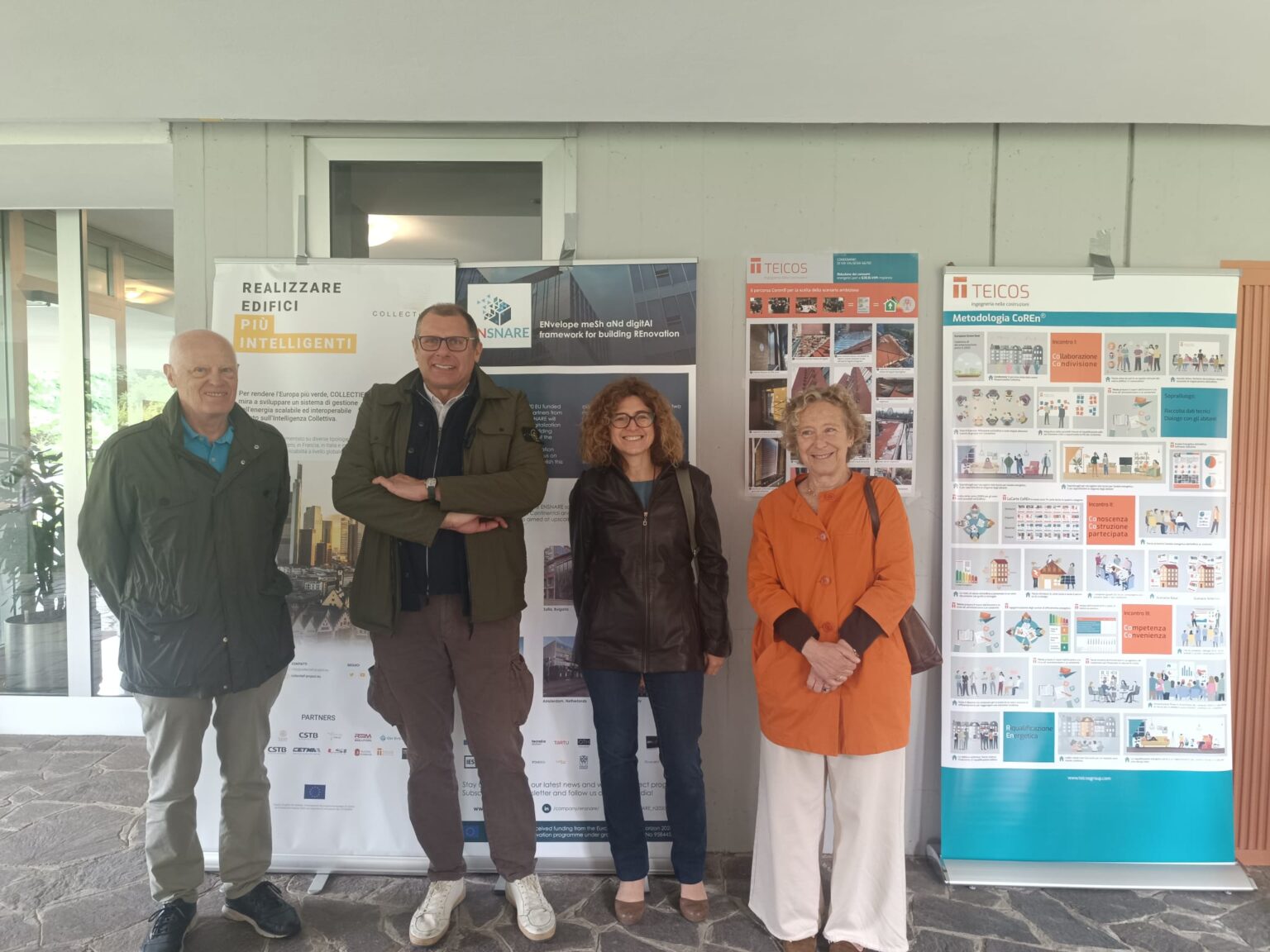
The complex served as a pilot for three European projects: COLLECTiEF, ENSNARE, and SPICA, which led to the installation of various sensors for ongoing monitoring and analysis that will continue through 2026.
One of the European research projects the Valsesia redevelopment is involved in is COLLECTiEF (Collective intelligence for energy flexibility – collectief-project.eu), which aims to use a network of smart sensors and collective intelligence algorithms to manage building systems, improving indoor comfort and reducing energy consumption. Specifically, smart thermostatic valves were installed in various buildings to remotely regulate radiator output; smart plugs allow remote activation and deactivation of electrical appliances based on real-time data; and additional sensors communicate temperature, humidity, and pollutant levels to a proprietary analytics network.
The second European project is ENSNARE (Envelope mesh and digital framework for building renovation – ensnare.eu), which aims to create a digital 3D model of one Valsesia building to prototype a specific technological solution: a prefabricated façade system equipped with solar and ventilation installations. This enables simulations and data collection for future renovations of similar buildings. European partners have adopted this approach and launched similar studies on various residential buildings. A weather station has also been installed on the selected building to monitor air quality parameters such as PM10 levels, alongside the COLLECTiEF sensors, making this condominium an excellent tool for performance analysis.
The Valsesia complex is also part of the SPICA Project (Sharing Power Information for Citizen Awareness) funded by the Lombardy Region. It provided for the installation of sensors to assess improvements in residential comfort after the energy renovation. The data collected has been analysed and shared by the Department of Industrial Engineering at the University of Padua.
Data on Residential Comfort
Sensor data confirms that the deep renovation improved internal thermal comfort in both winter and summer, reducing heat flow through walls and maintaining stable indoor temperatures. Sensors installed in apartments without air conditioning showed that after Teicos's intervention (carried out in May and June 2021), indoor temperatures no longer reached the extreme peaks experienced before. During the hottest months, the renovation lowered maximum indoor temperatures by 2 to 5 °C compared to pre-renovation levels — without the use of air conditioning.
In winter, comfort improvement isn’t directly quantifiable by indoor temperature, as that depends on the existing heating system. However, the renovation slowed the cooling of apartments after heating was turned off. Post-renovation, temperature fluctuations in apartments were significantly reduced (0.5–1 °C compared to 1.5 °C).
]]>